 By iVALT
Probability ≠ Proof
A risk engine can determine that an action appears safe. It cannot prove that the RIGHT human intends that specific action now.
What is the difference between AI risk scoring and human authority?
AI risk scoring estimates whether an action appears acceptable based on available signals. Human authority proves whether the required human intentionally approved the specific action. A low risk score does not prove that the RIGHT human authorized the action.
AI governance platforms are becoming increasingly sophisticated.
They can evaluate an agent’s identity, permissions, behavior, requested action, data access, transaction value, location, historical patterns, policy deviations, and other contextual signals.
They can calculate risk. They can detect anomalies. They can restrict tools. They can escalate activity. They can stop actions that appear dangerous. These capabilities are essential.
As AI agents gain the ability to interact with more systems and take more consequential actions, enterprises need increasingly strong governance, monitoring, and risk controls. But there is an important distinction:
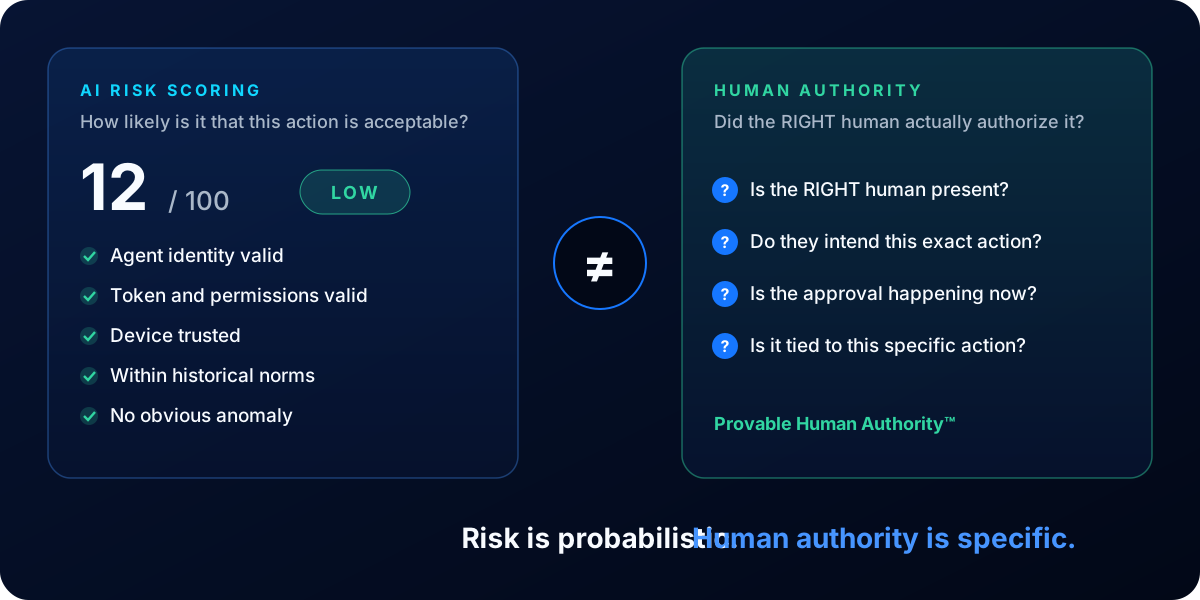
Risk is probabilistic. Human authority is specific.
A risk engine can determine that an action is likely safe. It can determine that an action resembles something previously approved. It can determine that a user, device, agent, location, or transaction appears normal.
What it cannot independently prove is whether the RIGHT human intended this specific action now. That becomes a very different security question.
Key Takeaways
- AI risk scoring estimates whether an action appears acceptable based on available signals. Human authority proves whether the required human intentionally approved the specific action.
- A low risk score does not prove that the RIGHT human authorized the action.
- Risk scoring should determine when stronger proof is required — not replace that proof.
- A human approval screen is not automatically proof of the RIGHT human. Approval should be bound to the exact action.
- Provable Human Authority™ complements AI governance, risk engines, IAM, and PAM — it does not replace them.
AI Risk Management Is Necessary
Risk management is becoming foundational to enterprise AI.
NIST’s AI Risk Management Framework organizes AI risk activities around four functions: Govern, Map, Measure, and Manage, with governance operating across the AI lifecycle. That is exactly the kind of discipline organizations need.
AI systems should be continuously evaluated. Agents should be monitored. Permissions should be constrained. Risk tolerances should be defined. Organizations should know which systems can access sensitive information, which tools they can invoke, which actions they can perform, and when additional controls are required.
But risk management and proof serve different purposes. A risk system is designed to answer questions such as:
- Does this behavior look abnormal?
- Is this action outside expected policy?
- Is the transaction unusually large?
- Is the agent operating from an unexpected context?
- Should this action require additional review?
Those are extremely valuable questions. They are not the same as asking: Did the RIGHT human personally authorize this specific action?
Probability Is Not Proof
Consider an AI agent attempting to:
- releasing a significant payment
- sending confidential information outside the organization
- modifying production infrastructure
- approving a contract
- changing privileged access
- deleting sensitive data
- altering a financial record
- executing an irreversible command
The environment may look completely normal.
The agent may have a valid identity. Its token may be valid. Its permissions may be correct. The user’s account may be legitimate. The device may be trusted. The transaction may fall within historical norms. The behavior may show no obvious anomaly. The risk score may be low.
But none of those observations prove that the human actually intended that exact action.
Every risk signal can appear acceptable while the final action is still wrong.
The agent could have misunderstood its objective. Its instructions could have been manipulated. It could have received incorrect or adversarial information. A legitimate session could have been compromised. The human may have authorized a general workflow without authorizing the specific action that ultimately resulted. Or the agent may simply be interpreting a valid instruction differently than the human expected.
Human Intent Is a Different Security Assertion
Digital security systems evaluate many kinds of evidence.
Identity systems establish who or what is authenticated. Authorization systems establish what an identity is permitted to do. AI governance establishes policies around how an AI system or agent should behave. Risk engines evaluate signals and estimate whether a request should be trusted, challenged, or stopped.
But human intent is a separate assertion. It asks:
- Is the RIGHT human actually present?
- Does that human know what action is being requested?
- Does that human intend for this action to occur?
- Is the approval happening now?
- Is the approval tied to this exact action?
Those questions cannot always be answered by analyzing the behavior of the agent, session, device, account, or transaction. At some point, the human must become part of the evidence.
AI Risk Scoring Should Determine When Proof Is Required
This does not mean AI risk scoring has failed. It means risk scoring should help determine when stronger proof is necessary.
The governance platform can define checkpoints based on risk level, policy deviation, transaction value, data sensitivity, privilege level, location, time, irreversibility, business impact, regulatory requirements, agent autonomy, or the requested tool or action.
Routine activity can continue without unnecessary friction. But when the system reaches a consequential threshold, the workflow can pause and request stronger evidence.
Microsoft’s current guidance for AI agents similarly emphasizes defining which decisions agents can make autonomously and which require human intervention, particularly for high-impact or ambiguous actions (Microsoft — Manage Agentic Risk).
OWASP’s agent-security guidance likewise recommends explicit human approval for high-impact or irreversible actions and recommends binding that approval to the exact action being performed (OWASP AI Agent Security Cheat Sheet).
The direction is clear: risk determines when additional authority is required. The next question is how that authority is proven.
Human Approval Is Not Automatically Human Proof
Adding a Human-in-the-Loop™ step is valuable. But the existence of an approval screen does not, by itself, establish the identity and intent of the human behind the approval.
Imagine an agent reaches a high-risk threshold. The system sends an approval request. Someone clicks “Approve.” What has actually been proven?
- Was it the correct human?
- Was the approval performed from an already compromised session?
- Was the person approving the exact action that ultimately executed?
- Was the approval fresh?
- Was it tied cryptographically to the action?
- Was the required context satisfied?
The enterprise may have successfully inserted a human step while still inheriting trust from the same environment that produced the request. For consequential actions, that may not be enough.
The goal should not simply be
“A human approved something.”
The stronger assertion is
“The RIGHT human authorized this specific action at this specific moment.”
AI Risk Scoring vs. Human Authority: Different Problems
This creates a simple model.
| Dimension | AI risk scoring | Human authority |
|---|---|---|
| The question it answers | How likely is it that this action is acceptable? | Did the RIGHT human actually authorize it? |
| Nature of the answer | Probabilistic — an inference from signals | Specific — an assertion of authority |
| What it evaluates | Identity, permissions, behavior, context, transaction value, policy deviation | The required human, the exact action, and the moment of approval |
| Its role | Determines when human authority is required | Establishes that the authority is real |
Both matter. And they work best together.
A sophisticated risk platform can process thousands of signals faster than any human could. It can allow routine actions to proceed automatically. It can identify unusual patterns. It can detect policy violations. It can determine when autonomy should stop. That is exactly what the enterprise needs.
But when autonomy stops, something else is required. At that moment, the organization needs reliable evidence of the human authority behind the decision.
The Higher the Consequence, the More Important the Distinction
Not every AI action should require human approval. That would eliminate much of the value of automation. The objective is not to put a person in front of every decision.
The objective is to identify the decisions where the consequence of being wrong is materially greater than the cost of requiring proof. Consider the difference between an AI agent:
- Reading a documentDeleting a production database
- Drafting an emailSending confidential financial information externally
- Analyzing a transactionReleasing the payment
The appropriate control should change with the consequence. This is why risk scoring is so valuable. It helps the organization determine where the threshold should exist.
But once the threshold is crossed, the enterprise should not simply ask for another probability. It should be able to prove the authority behind the action.
AI Governance Is Moving Toward Decision Rights
The market is already moving in this direction.
Microsoft describes mature agent governance as including clear decision rights, defined human oversight, escalation paths, monitoring, and accountability (Microsoft — Security & Governance for AI Agents). NIST similarly emphasizes continuous governance, risk management, human review, and oversight across the AI lifecycle.
These controls are not evidence that risk scoring is inadequate. They demonstrate that risk management has limits by design.
Risk management tells the organization when confidence is sufficient. Human authority becomes important when confidence alone is no longer enough.
Action-Bound Approval: The Action Must Be Bound to the Approval
There is another important distinction. A generic approval is weaker than an approval tied to the exact action being executed.
Generic approval
“Do you approve this agent?”
Action-bound approval
“Do you authorize this agent to transfer $2.4 million to this recipient now?”
The second approval establishes far more useful evidence.
OWASP’s current agent-security guidance recommends binding human approval to the exact action, including the actor, tool, target resource, parameters, timestamp, and expiry for high-impact operations. That reflects an important principle: authority should be action-specific.
The enterprise should not inherit unlimited future authority from a previous approval. A human approving one action does not mean every later action performed by the agent should automatically inherit that approval. (We explored that inherited-trust problem in AI Agent Identity Is Not Human Authority.)
AI Will Become Better at Predicting Intent
AI systems will continue to improve. Risk models will become more accurate. Behavioral analysis will become more sophisticated. Agents will become better at understanding context. Security platforms will process larger numbers of signals. That is all valuable.
But prediction and proof remain different concepts. A system may eventually become exceptionally good at predicting what a human probably wants. It still cannot turn that prediction into historical evidence that the human actually authorized a particular consequential action.
The distinction matters most when accountability matters: payments, contracts, privilege changes, production changes, sensitive information, critical infrastructure, and irreversible actions.
The highest-risk decisions deserve a different standard.
For Security & AI Leaders
Find the AI actions where confidence is not enough.
Walk through your highest-consequence AI agent workflows with the iVALT team.
AI Risk Scoring and Human Authority: Frequently Asked Questions
Can AI risk scoring prove human intent?
No. AI risk scoring can evaluate signals such as identity, permissions, behavior, context, transaction value, and policy deviation to estimate whether an action appears acceptable. It does not independently prove that the RIGHT human intentionally authorized a specific action at that moment. A low risk score does not prove that the RIGHT human authorized the action.
What is the difference between AI risk scoring and human authority?
AI risk scoring estimates whether an action appears acceptable based on available signals. Human authority proves whether the required human intentionally approved the specific action. Risk is probabilistic; authority is action-specific.
When should an AI agent require human approval?
Organizations should consider human approval for actions that are high-impact, irreversible, financially significant, privileged, sensitive, regulated, or outside defined risk tolerances.
What is action-bound human approval?
Action-bound human approval connects the human’s authorization to the exact action being requested rather than relying on a generic or previously inherited approval. OWASP recommends binding approval for high-impact operations to the actor, tool, target resource, parameters, timestamp, and expiry. This creates stronger evidence that the human understood and approved the specific consequential action.
Does Provable Human Authority™ replace AI governance?
No. The AI governance or risk platform continues to define policy, calculate risk, establish thresholds, and determine whether execution proceeds. iVALT is designed to provide Provable Human Authority™ at enterprise-defined checkpoints where stronger human proof is required.
Does a low risk score mean an AI agent’s action is authorized?
No. A risk system may correctly conclude that there is no strong evidence an action is malicious. That is not equivalent to proof that the required human authorized the action. The first is an inference. The second is an assertion of authority.
Is a Human-in-the-Loop™ approval step enough on its own?
Not always. Adding a Human-in-the-Loop™ step is valuable, but the existence of an approval screen does not, by itself, establish the identity and intent of the human behind the approval. For consequential actions, the stronger assertion is that the RIGHT human authorized this specific action at this specific moment.